
🌏 日本語版はこちら:【2026明治杯 全日本選抜】MSW指標で読み解く全30階級
- Introduction — The 2026 Meiji Cup, in Full
- What is the MSW Metric? — A Yardstick for the Quality of Dominance
- Men’s Freestyle — Yoshida’s Shutouts, Yamamoto’s Lightning Finishes
- Men’s Greco-Roman — Fumita’s Composure, Yoshida’s Forward Pressure
- Women’s — Two Olympians Set the Tone
- Full MSW Rankings — All 30 Categories
- Closing — What Lies Beyond the Numbers
Introduction — The 2026 Meiji Cup, in Full
From May 21 to 24, 2026, the All-Japan Wrestling Championships (Meiji Cup) 2026 were held at the Komazawa Olympic Park General Sports Ground in Tokyo. The Meiji Cup is one of Japan’s two pillar domestic tournaments, and this edition doubled as the selection event for both the 2026 World Championships in September and the Asian Games in August. For wrestlers chasing a place on Japan’s national team, it was the most important meet of the first half of the season.
A total of 30 weight categories were contested: 10 men’s freestyle (FS), 10 men’s Greco-Roman (GR), and 10 women’s (WW).
In this article, I want to look beyond the obvious question of “who won” and use a researcher’s lens to ask a different one: how dominantly did each champion win? To do that, I’ll use a metric called MSW (Most Successful Wrestler), which compresses the texture of a wrestler’s performance into a single number.
Let’s read the “quality of winning” through the numbers.
What is the MSW Metric? — A Yardstick for the Quality of Dominance
Definition
MSW (Most Successful Wrestler) is a summary metric for the content of a wrestler’s matches at a single tournament.
MSW = WQ + CPdiff
The structure is simple — just two terms added together — but each component captures the quality of winning from a different angle.
WQ (Win Quality) — Time Efficiency
WQ = (TP scored − TP conceded) ÷ Total match time (minutes)
WQ measures how many points per minute a wrestler outscored their opponents by. A WQ of 3.0, for example, means the wrestler was, on average, outscoring opponents by three technical points every minute on the mat. The faster and more lopsided the victories, the higher this value climbs.
CPdiff (Classification Point Difference) — The Grade of the Win
CPdiff = (CP scored − CP conceded) ÷ Number of bouts
In wrestling, the manner of victory is rewarded with a different number of Classification Points (CP). The cleaner and more decisive the win, the higher the CP.
- VFA — Victory by Fall — 5 CP
- VSU — Victory by Technical Superiority (opponent scoreless) — 4 CP
- VSU1 — Victory by Technical Superiority (opponent scoring) — 4 CP
- VPO — Victory by Points (opponent scoring) — 3 CP
CPdiff is therefore the average CP swing per bout — wrestlers who pile up falls and technical superiority wins push this value up quickly.
How to Read MSW
The higher the MSW value, the more dominantly the wrestler won — fast, by large margins, and with high-grade victories.
A wrestler with a high WQ but many narrow decisions will not see CPdiff climb. A wrestler with several falls who also concedes points will see WQ drop. The metric is designed to reward both qualities simultaneously.
Men’s Freestyle — Yoshida’s Shutouts, Yamamoto’s Lightning Finishes
FS MSW Top 5
| Rank | Weight | Wrestler | Team | Bouts | Total Match Time | TP (For-Against) | CP (For-Against) | MSW |
|---|---|---|---|---|---|---|---|---|
| 1 | 97kg | Arashi YOSHIDA | Sane Kaiun | 3 | 11:10 | 31-0 | 12-0 | 6.78 |
| 2 | 125kg | Taiki YAMAMOTO | Self-Defense Forces | 3 | 7:18 | 22-1 | 11-1 | 6.21 |
| 3 | 79kg | Keiwan GAREDAGI | Waseda University | 3 | 13:16 | 25-0 | 11-0 | 5.55 |
| 4 | 86kg | Hayato ISHIGURO | Self-Defense Forces | 3 | 11:12 | 27-2 | 11-2 | 5.23 |
| 5 | 74kg | Yoshinosuke AOYAGI | Cleanup Corp. | 3 | 16:56 | 25-8 | 13-1 | 5.00 |
No. 1: Arashi Yoshida (97kg) — A Flawless Tournament
Across three bouts, Yoshida posted 31 points scored and zero conceded, with a CP swing of 12-0. His WQ of 2.78 points per minute and CPdiff of 4.0 per bout are both elite, and the balance between the two is what pushes his MSW to a tournament-leading 6.78.
A clean sheet at this level is never just a product of “being strong.” It takes the tactical discipline to keep the bout on your own terms, plus the maturity to resist risky attacks even when an opening seems to be there.
For several years, 97 kg has been a weight class where Japan has struggled to make a dent at the world level. Yoshida is already breaking through, and his calling card is his hand fighting — by controlling the tie-ups he denies opponents access to their preferred positions. That control was the foundation of his shutout run in Tokyo.
No. 2: Taiki Yamamoto (125kg) — Heavyweight Efficiency
The number to stare at here is total match time across three bouts: 7 minutes 18 seconds. A WQ of 2.88 in the heaviest division is, frankly, extraordinary.
Heavyweight matches usually drag — bodies are big, exchanges are cautious, and points come slowly. Yamamoto refused to play that game, winning two of his three bouts by technical superiority and the other by decision, in an average of about two and a half minutes apiece. From a tournament-management standpoint this is close to the ideal: minimum energy spent, maximum CP earned. The takedown speed he showed is genuinely unusual for the weight class.
No. 3: Keiwan Garedagi (79kg) — A Reigning Asian Champion Goes Unscored On
The reigning Asian champion from Waseda University also kept his slate at zero conceded. His total match time was a touch longer than Yoshida’s at just over 13 minutes, which reflects the difficulty of his bracket as much as anything else. From start to finish, his wrestling looked steady and in control.
Men’s Greco-Roman — Fumita’s Composure, Yoshida’s Forward Pressure
GR MSW Top 5
| Rank | Weight | Wrestler | Team | Bouts | Total Match Time | TP (For-Against) | CP (For-Against) | MSW |
|---|---|---|---|---|---|---|---|---|
| 1 | 63kg | Kenichiro FUMITA | Miki House | 3 | 10:10 | 26-1 | 11-1 | 5.79 |
| 2 | 87kg | Taizo YOSHIDA | Nippon Sport Science Univ. | 3 | 8:32 | 21-4 | 11-1 | 5.33 |
| 3 | 97kg | Yuri NAKAZATO | Matsuo Construction | 3 | 13:14 | 24-3 | 11-1 | 4.92 |
| 4 | 67kg | Kyotaro SOGABE | ALSOK | 3 | 13:39 | 22-1 | 11-1 | 4.87 |
| 5 | 82kg | Tatsuya FUJII | Ritto City Office | 3 | 12:21 | 24-4 | 11-2 | 4.62 |
No. 1: Kenichiro Fumita (63kg) — A Veteran’s Unshakable Edge
Fumita, a two-time Olympian (Tokyo and Paris), is back on top of the All-Japan podium. Over three bouts he scored 26 points to 1, with a CP swing of 11-1. Both his WQ and CPdiff are the highest in Greco-Roman.
Fumita’s wrestling isn’t only about the dynamic throws he’s famous for. The other half of the picture — and the half MSW rewards — is that he simply doesn’t let opponents score. That combination is the textbook profile of an MSW-efficient champion.
No. 2: Taizo Yoshida (87kg) — A Student-Athlete With a Senior’s Match Time
The Nippon Sport Science University wrestler closed all three of his bouts in a combined 8 minutes 32 seconds — a strikingly short total for Greco-Roman. His WQ of 2.0 reflects an aggressive, point-scoring style. The final itself was tight, but he found another gear late in the bout and used his trademark forward pressure to overturn the score. Winning a close one says as much about his composure as his offense.
No. 3: Yuri Nakazato (97kg) — Cumulative Control
Nakazato’s bouts were longer (just over 13 minutes total), but the score lines — TP +21, CP +10 — show a wrestler who steadily piled up points throughout each match. He avenged an Emperor’s Cup loss to Tsuruta in the final, then carried that momentum into the playoff to lock down the national team spot.
Women’s — Two Olympians Set the Tone
WW MSW Top 5
| Rank | Weight | Wrestler | Team | Bouts | Total Match Time | TP (For-Against) | CP (For-Against) | MSW |
|---|---|---|---|---|---|---|---|---|
| 1 | 57kg | Akari FUJINAMI | Restar | 3 | 11:01 | 29-0 | 11-0 | 6.30 |
| 2 | 50kg | Yui SUSAKI | Kitz | 3 | 10:16 | 22-3 | 14-1 | 6.18 |
| 3 | 72kg | Shirin TAKEMOTO | Ikuei University | 3 | 12:33 | 32-6 | 11-1 | 5.41 |
| 4 | 53kg | Moe KIYOOKA | ALSOK | 3 | 11:55 | 25-1 | 11-1 | 5.35 |
| 5 | 68kg | Ami ISHII | Cleanup Corp. | 5 | 22:37 | 40-5 | 18-2 | 4.75 |
No. 1: Akari Fujinami (57kg) — The Streak Rolls On
Three bouts. 29 points scored, zero conceded. CP swing of 11-0. WQ of 2.63, CPdiff of 3.67, and an MSW of 6.30 that tops the women’s draw.
What stands out about Fujinami isn’t fireworks — it’s steadiness. A combined match time of 11 minutes 1 second with no points conceded means she never loses her rhythm, not even in a final where most wrestlers tighten up.
Fujinami’s unbeaten streak has continued to grow since Paris. The pressure that must come with that record is hard to imagine from the outside, and how far this run extends is one of the most interesting things to watch in the sport right now.
No. 2: Yui Susaki (50kg) — Winning By Grade, Not Just By Score
The number to look at here is CP scored 14, conceded 1. That means she won every bout by a high-grade method — falls and technical superiority. Her WQ isn’t the highest on the women’s side, but her CPdiff of 4.33 is in a league of its own.
“More dominant than the score line suggests.” This is exactly the phenomenon I wanted MSW to capture when I designed it. Susaki sealed the final with an uchi-musou fall. She is best known for her takedowns and gut wrenches, but this tournament was a reminder that her arsenal is much broader than that.
No. 3: Shirin Takemoto (72kg) — Heavyweight Scoring Power
Thirty-two points scored across three bouts, with a TP swing of +26 — both among the very best on the women’s side. Takemoto, of Ikuei University, is rapidly becoming the face of a new generation in the women’s upper weight classes. She knocked out reigning Emperor’s Cup champion Yoshitake in the semifinal — a major scalp. Yoshitake got her own back in the playoff, but the trajectory here is clearly upward.
Full MSW Rankings — All 30 Categories
Men’s Freestyle (FS)
| Rank | Weight | Wrestler | Team | MSW |
|---|---|---|---|---|
| 1 | 97kg | Arashi YOSHIDA | Sankei Kaiun | 6.78 |
| 2 | 125kg | Taiki YAMAMOTO | Self-Defense Forces | 6.21 |
| 3 | 79kg | Keiwan GAREDAGI | Waseda University | 5.55 |
| 4 | 86kg | Hayato ISHIGURO | Self-Defense Forces | 5.23 |
| 5 | 74kg | Yoshinosuke AOYAGI | Cleanup Corp. | 5.00 |
| 6 | 61kg | Rei HIGUCHI | Miki House | 4.55 |
| 7 | 92kg | Sorato KANAZAWA | Waseda University | 3.94 |
| 8 | 65kg | Kotaro KIYOOKA | Kakushin Group | 3.91 |
| 9 | 57kg | Rikuto NAGAI | Nihon University | 3.28 |
| 10 | 70kg | Yuma TOMIYAMA | Self-Defense Forces | 2.58 |
Men’s Greco-Roman (GR)
| Rank | Weight | Wrestler | Team | MSW |
|---|---|---|---|---|
| 1 | 63kg | Kenichiro FUMITA | Miki House | 5.79 |
| 2 | 87kg | Taizo YOSHIDA | Nippon Sport Science Univ. | 5.33 |
| 3 | 97kg | Yuri NAKAZATO | Matsuo Construction | 4.92 |
| 4 | 67kg | Kyotaro SOGABE | ALSOK | 4.87 |
| 5 | 82kg | Tatsuya FUJII | Ritto City Office | 4.62 |
| 6 | 72kg | Rintaro SOGABE | aiwabenefit | 3.74 |
| 7 | 77kg | Nao KUSAKA | Maruhan Kita-Nihon | 3.54 |
| 8 | 130kg | Sota OKUMURA | Self-Defense Forces | 2.50 |
| 9 | 60kg | Ayata SUZUKI | Leicester | 2.33 |
| 10 | 55kg | Kagetora OKAMOTO | Senshu Club | 2.25 |
Women’s (WW)
| Rank | Weight | Wrestler | Team | MSW |
|---|---|---|---|---|
| 1 | 57kg | Akari FUJINAMI | Leicester | 6.30 |
| 2 | 50kg | Yui SUSAKI | Kitz | 6.18 |
| 3 | 72kg | Shirin TAKEMOTO | Ikuei University | 5.41 |
| 4 | 53kg | Moe KIYOOKA | ALSOK | 5.35 |
| 5 | 68kg | Ami ISHII | Cleanup Corp. | 4.75 |
| 6 | 65kg | Nana IKEHATA | Ikuei University | 3.89 |
| 7 | 76kg | Yuka KAGAMI | Suntory | 3.70 |
| 8 | 62kg | Nonoka OSAKI | Keio University | 3.41 |
| 9 | 55kg | Nagisa HARADA | Ikuei University | 3.22 |
| 10 | 59kg | Natsuki YAMAGUCHI | Self-Defense Forces | 2.17 |
Closing — What Lies Beyond the Numbers
Thank you for reading this far.
A metric like MSW is a tool for reading what happened on the mat, not a verdict on any wrestler’s strength. The bracket they drew, their condition on the day, the specific opponents they had to face — there are countless factors behind every result that no formula will ever capture.
Even so, I think there is real value in letting the numbers pose the questions. Why does Yoshida go entire tournaments without conceding a point? How does Fujinami keep her rhythm in the most pressurized finals? These are exactly the kinds of questions I find most useful — questions that send you back and forth between the lab and the mat, between research and the field. That’s the conversation I’ve been having on this site for a long time, and one I want to keep having.
Book Announcement (Coming September 2026)
The MSW analysis above is a small piece of a larger project: a book that brings the same kind of scientific, data-informed lens to wrestling as a whole. It is scheduled for release in September 2026.
Exploring Wrestling: An Anatomical Atlas of the Sport Without a Definitive Answer, Drawn by Science and the Field
Author: ITO Sho (伊藤 奨)
The book brings together practical knowledge for parents and coaches alongside structured explanations of metrics like the one in this article, all supported by figures and diagrams. More details will be shared here on the site as the release date approaches.
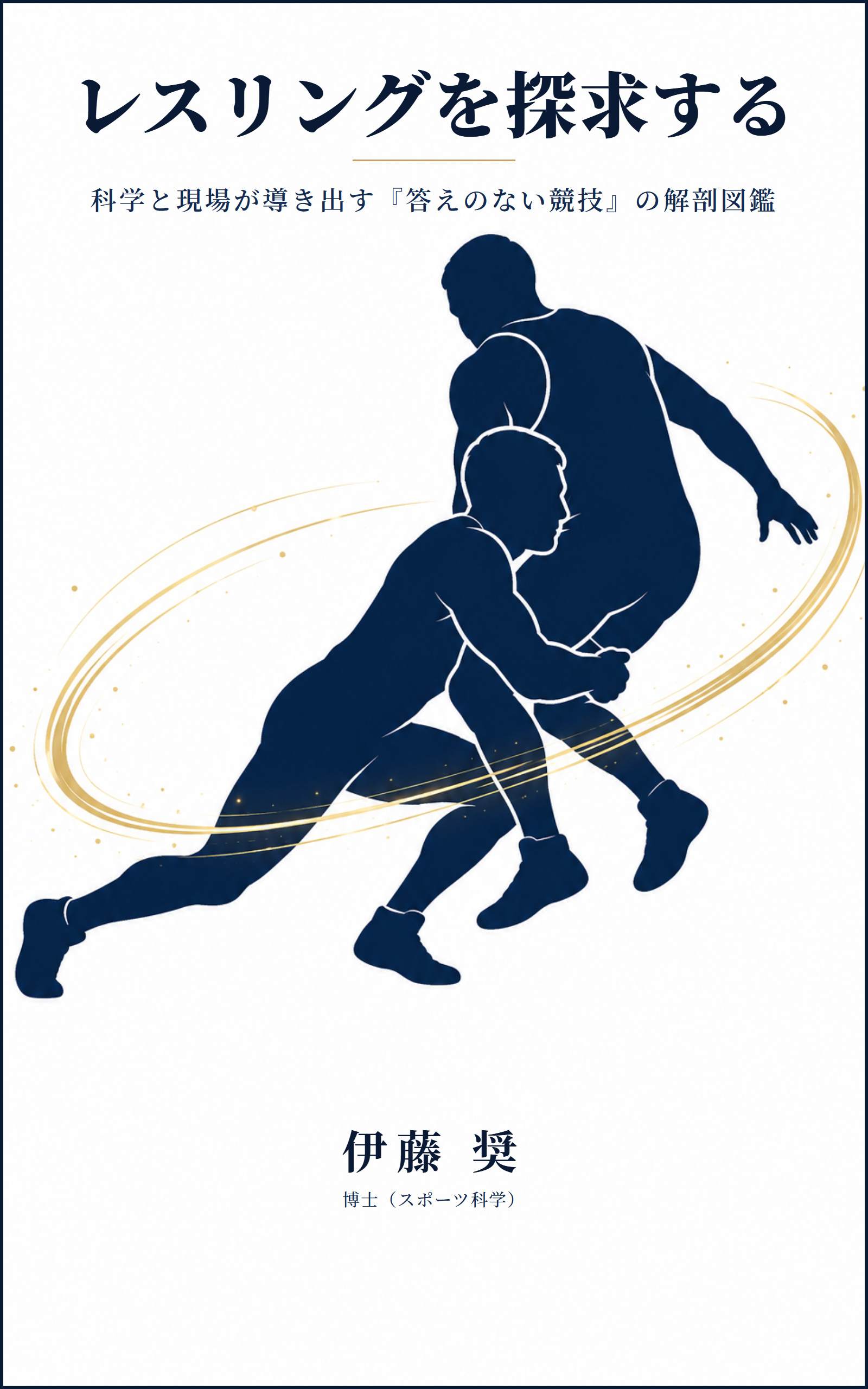
The author of this blog has written a Japanese-language book that examines the hidden mechanisms of wrestling from both research and coaching perspectives. Kindle edition 1,250 yen, paperback 2,500 yen, also included with Kindle Unlimited.
View on Amazon (out September 23) →
Release updates are sent through our official LINE account. / See the book page


コメント