🌏 日本語版はこちら:【2026アジア大会 愛知・名古屋】日本15メダル― DI指数で読み解く全18階級
Introduction
The 20th Asian Games wrestling event (Aichi-Nagoya 2026) ran from September 30 to October 3, 2026, at the Nagoya City Inae Sports Center. As a once-in-four-years stage held on home soil, this was surely an event that fired up Team Japan more than a typical international competition does.
The final tally: 7 gold, 4 silver, 4 bronze — 15 medals in total. Women took gold in five of their six weight classes, and Greco-Roman produced two gold medalists, making it a four-day medal rush.
In this report, we review the key moments and the full 18-class results through the lens of DI (Dominance Index), an original time-independent metric we built to capture how emphatically each gold medalist won their bracket.
What Is DI? A Time-Independent Way to Measure the Quality of a Win
Two gold medals can look the same on paper, yet what happened inside the matches (that is, how each title was won) differs a great deal. To boil down how dominantly each gold medalist controlled the bracket into a single number, this report uses an original index called DI (Dominance Index).
- DI = TPdiff/bout + CPdiff
- TPdiff/bout — technical-point differential per bout: (total TP for − total TP against) ÷ number of bouts.
- CPdiff — classification-point differential per bout: VFA (victory by fall) = 5 CP, VSU (victory by technical superiority) = 4 CP, VPO (victory by points) = 3 CP, and so on; computed as (sum of CP for − sum of CP against) ÷ number of bouts.
In plain English, DI adds up (a) how many technical points you outscore your opponents by per bout and (b) how overwhelmingly you win. A wrestler who rolls through the bracket with VSU and VFA finishes with a far higher DI than one who grinds out close VPO decisions.
This index was reworked with reference to MSW (Most Successful Wrestler), the framework proposed by Dr. Kristijan Slacanac of UWW Performance Data Analysis. MSW uses points per minute, which requires reliable per-bout match times — and those times are not posted on the official site, forcing analysts to work from estimates. We therefore rebuilt the index into a time-independent form and called it DI. The underlying idea — that two gold medals are rarely the same — is the same as MSW’s; the only difference is that DI does not use match time anywhere in the calculation.
One brief note on reading DI: it is not a predictive power ranking. A wrestler can post a huge DI in a single tournament and lose a close final at the next one. The value of the figure is that it summarizes how a bracket was won, not whether a particular athlete is favored going forward. For that reason, DI works best alongside match video and bracket context, not as a replacement for them.
Category Highlights
Women’s Wrestling (WW) — Five Golds Out of Six
- 50kg Susaki Yui (Kitz, gold): 10-0 VSU over PRK’s KIM Son Hyang in the final. The numbers reinforce the stability she has shown since her Paris gold.
- 53kg Kiyooka Moe (ALSOK, gold): 9-1 VPO1 over India’s ANTIM.
- 62kg Ozaki Nonoka (Keio OG, gold): 3-0 VPO against PRK’s KIM Ok Ju.
- 68kg Ishii Ami (Cleanup, gold): 7-2 VPO1 over PRK’s PAK Sol Gum.
- 76kg Kagami Yuka (Suntory, gold): 5-1 VPO1 over Kazakhstan’s SYZDYKOVA.
- 57kg Fujinami Akari (Lester Gym, bronze): fell to PRK’s SON Il Sim by fall in the semifinal.
Japan took gold in every weight class except Fujinami’s 57kg. It was a tournament that showed other nations just how strong Japanese women’s wrestling is.
Men’s Freestyle (FS) — Zero Gold, Two Silver and Two Bronze
Men’s Freestyle took no gold. 74kg Aoyagi Yoshinosuke (Cleanup, silver) and 86kg Ishiguro Hayato (JSDF, silver) reached their finals. 65kg Kiyooka Kotaro (Kakushin Group, bronze) dropped the semifinal 3-3 on criteria to India’s SUJEET but recovered in the bronze-medal match, beating Iran’s EBRAHIMZADEHSAVADKOUHI 3-2. 97kg Yoshida Arashi rounded out the Japanese FS medals with another bronze. At 57kg, Ogawa Yamato lost the bronze-medal match 1-1 on criteria to Tajikistan’s BELOLYUBSKII and finished fifth. Four FS medals in total: two silver and two bronze.
Greco-Roman (GR) — Japan Takes Gold at 87 and 97kg
- 87kg Yoshida Taizo (Nippon Sport Science University, gold): 11-1 VSU1 over Kyrgyzstan’s ZHANYSHOV. A high-TPdiff, high-CPdiff run through the bracket.
- 97kg Nakazato Yuri (Matsuo Construction, gold): 4-0 VPO shutout of India’s NITESH. A final defined by defensive discipline.
The Greco squad added Suzuki Ayata’s bronze at 60kg, Sogabe Kyotaro’s silver at 67kg, and Kusaka Nao’s silver at 77kg. Five medals from six weight classes.
Full Results Across All 18 Classes
| Class | Gold | Silver | Bronze |
|---|---|---|---|
| FS 57kg | AMAN (IND) | HAN Chong Song (PRK) | ZOU Wanhao (CHN) / BELOLYUBSKII Aiaal (TJK) |
| FS 65kg | SUJEET (IND) | KUDIEV Abdulmazhid (TJK) | KIYOOKA Kotaro (JPN) / KUULAR Nachyn (KAZ) |
| FS 74kg | EMAMICHOGHAEI (IRI) | AOYAGI Yoshinosuke (JPN) | RASSADIN (TJK) / KAIPANOV (KAZ) |
| FS 86kg | NOKHODILARIMI (IRI) | ISHIGURO Hayato (JPN) | OLONBAYAR (MGL) / SHAVAEV Malik (KGZ) |
| FS 97kg | AZARPIRA (IRI) | POYONOV (UZB) | PUNIA (IND) / YOSHIDA Arash (JPN) |
| FS 125kg | ZARE Amir Hossein (IRI) | BUHEEERDUN (CHN) | SHARIPOV (BRN) / KASSIMBEK (KAZ) |
| GR 60kg | SHARSHENBEKOV (KGZ) | GANIEV (UZB) | ALBIDHAN (IRQ) / SUZUKI Ayata (JPN) |
| GR 67kg | KHALMAKHANOV (UZB) | SOGABE Kyotaro (JPN) | BEISHEKEEV (KGZ) / SHERMAKHANBET (KAZ) |
| GR 77kg | ABDEVALI (IRI) | KUSAKA Nao (JPN) | MAKHMUDOV (KGZ) / BADAGHIMOFRAD (QAT) |
| GR 87kg | YOSHIDA Taizo (JPN) | ZHANYSHOV (KGZ) | BERDIMURATOV (UZB) / SUNIL KUMAR (IND) |
| GR 97kg | NAKAZATO Yuri (JPN) | NITESH (IND) | GANBAATAR (MGL) / BALIHAMZEHDEH (IRI) |
| GR 130kg | MIRZAZADEH (IRI) | TSITSUASHVILI (UZB) | MENG Lingzhe (CHN) / KIM Minseok (KOR) |
| WW 50kg | SUSAKI Yui (JPN) | KIM Son Hyang (PRK) | BAYANOVA (KAZ) / FENG Ziqi (CHN) |
| WW 53kg | KIYOOKA Moe (JPN) | ANTIM (IND) | ZHANG Jin (CHN) / BAYANMUNKH (MGL) |
| WW 57kg | HONG Kexin (CHN) | SON Il Sim (PRK) | RAIMOVA (KAZ) / FUJINAMI Akari (JPN) |
| WW 62kg | OZAKI Nonoka (JPN) | KIM Ok Ju (PRK) | TOGTOKH (MGL) / ZHANG Qi (CHN) |
| WW 68kg | ISHII Ami (JPN) | PAK Sol Gum (PRK) | ZHUMANAZAROVA (KGZ) / LONG Jia (CHN) |
| WW 76kg | KAGAMI Yuka (JPN) | SYZDYKOVA (KAZ) | MEDET KYZY (KGZ) / LI Wenji (CHN) |
DI Ranking by Style
We computed DI for every gold medalist from their full bout records. The higher the number, the more a wrestler built large margins over opponents and stacked up high-quality wins on the way to the title.
Men’s Freestyle (FS) — DI Ranking
| Rank | Weight | Country | Wrestler | Bouts | TP (+/−) | CP (+/−) | DI |
|---|---|---|---|---|---|---|---|
| 1 | 97kg | IRI | AZARPIRA Amirali | 4 | 34-3 | 15-1 | 11.25 |
| 2 | 125kg | IRI | ZARE Amir Hossein | 4 | 36-5 | 15-2 | 11.00 |
| 3 | 57kg | IND | AMAN AMAN | 4 | 57-25 | 14-4 | 10.50 |
| 4 | 86kg | IRI | NOKHODILARIMI Mohammad | 4 | 34-7 | 14-2 | 9.75 |
| 5 | 65kg | IND | SUJEET SUJEET | 4 | 36-15 | 14-3 | 8.00 |
| 6 | 74kg | IRI | EMAMICHOGHAEI Yones | 4 | 30-13 | 13-3 | 6.75 |
Iran (4) and India (2) take every FS gold. Japan collected 2 silvers and 2 bronzes, but no gold. The top FS DI is 11.25 (AZARPIRA) — close to the leading WW and GR numbers (both 14.00 at the very top) but not quite reaching them. In freestyle, the depth of the field this year did not let any single champion run away with a truly runaway stat line. The match against Yoshida Arashi has stirred some controversy, but we are confident Yoshida will take his revenge at the World Championships!
Men’s Greco-Roman (GR) — DI Ranking
| Rank | Weight | Country | Wrestler | Bouts | TP (+/−) | CP (+/−) | DI |
|---|---|---|---|---|---|---|---|
| 1 | 87kg | JPN | YOSHIDA Taizo | 3 | 32-1 | 12-1 | 14.00 |
| 2 | 60kg | KGZ | SHARSHENBEKOV Zholoman | 4 | 32-5 | 15-1 | 10.25 |
| 3 | 77kg | IRI | ABDEVALI Alireza | 3 | 22-3 | 11-1 | 9.67 |
| 4 | 67kg | UZB | KHALMAKHANOV Aytjan | 4 | 25-2 | 14-1 | 9.00 |
| 5 | 97kg | JPN | NAKAZATO Yuri | 3 | 19-4 | 10-1 | 8.00 |
| 6 | 130kg | IRI | MIRZAZADEH Amin | 3 | 11-2 | 9-2 | 5.33 |
YOSHIDA Taizo leads GR by a wide margin. All three of his bouts ended in VSU/VSU1, with a TP line of 32-1 and a CP line of 12-1 — a textbook “blowout” title run and the joint-highest DI of all 18 gold medalists. NAKAZATO Yuri sits fifth with a 19-4 TP line across three bouts: a quieter, defensively solid champion. For a Japanese wrestler to win this weight class at all is a remarkable achievement in itself.
Women’s Wrestling (WW) — DI Ranking
| Rank | Weight | Country | Wrestler | Bouts | TP (+/−) | CP (+/−) | DI |
|---|---|---|---|---|---|---|---|
| 1 | 53kg | JPN | KIYOOKA Moe | 4 | 43-1 | 15-1 | 14.00 |
| 2 | 50kg | JPN | SUSAKI Yui | 4 | 35-0 | 17-0 | 13.00 |
| 3 | 57kg | CHN | HONG Kexin | 4 | 33-2 | 16-1 | 11.50 |
| 4 | 62kg | JPN | OZAKI Nonoka | 3 | 21-0 | 10-0 | 10.33 |
| 5 | 68kg | JPN | ISHII Ami | 4 | 35-8 | 15-2 | 10.00 |
| 6 | 76kg | JPN | KAGAMI Yuka | 3 | 20-4 | 10-2 | 8.00 |
Japan takes five of the six WW golds. The top two overall are also Japanese — KIYOOKA Moe and SUSAKI Yui. KIYOOKA’s DI of 14.00 ties YOSHIDA Taizo for the top number across all 18 gold medalists: four bouts, a TP line of 43-1, a CP line of 15-1 — a per-bout gap of 10.5 technical points plus 3.5 classification points. SUSAKI’s 13.00 at number two is backed by four bouts with zero points conceded (CP 17-0), underscoring just how far clear the two Japanese women are from the rest of the field.
Across All Three Styles
The top three gold medalists by DI are all Japanese: a tie at the top, with YOSHIDA Taizo (GR 87kg, 14.00) level alongside KIYOOKA Moe (WW 53kg, 14.00), and SUSAKI Yui (WW 50kg, 13.00) right behind. It was a tournament where Japan showed its strength not only in the number of golds (7) but also in how overwhelmingly they were won. Men’s Freestyle, by contrast, topped out at a DI of 11.25 — a reminder that even in the style where no gold crossed over to Japan, no champion really ran away with it either.
Note: DI is a time-independent index. The Slacanac MSW framework uses points per minute and therefore requires reliable per-bout match times, which are not published on the official site. We rebuilt the index around per-bout differentials instead, so match time plays no role in the DI figures above.
Overall Assessment
Fifteen medals is a superb result, but the breakdown shows a clear imbalance: five golds on the women’s side, two in Greco, and none in Men’s Freestyle.
On the women’s side, Susaki, Kiyooka Moe, Ozaki, Ishii, and Kagami each took gold. The tactical breadth developed through the Paris cycle held up under the pressure of a home audience.
Men’s Freestyle collected four medals in total (2 silver, 2 bronze) without climbing the top step. The two silver medalists, Aoyagi at 74kg and Ishiguro at 86kg, both lost close finals to Iranian athletes. At 65kg, Kiyooka Kotaro lost the semifinal on criteria to India’s SUJEET before taking bronze. Judged by the number and color of the medals alone, Men’s Freestyle trails the women’s and Greco squads, but many of its losses were close ones, so we do not think there is much reason for pessimism.
Greco contributed golds from Yoshida Taizo (87kg) and Nakazato Yuri (97kg), plus silvers at 67 and 77kg and a bronze at 60kg. Across all six weight classes, five medalists. No team ranking was held at this tournament, but had there been one, Greco would have finished first, an impressive showing (per pinfall).
Looking across styles, one more pattern deserves attention. PRK (DPRK) athletes reached the final in four women’s weight classes (50, 57, 62, 68kg) and placed in multiple others. Any serious preparation for the 2026 Worlds has to include fresh scouting of their current roster, since they will show up in bronze-medal matches and finals alike.
A second cross-style note: India produced two Freestyle golds (AMAN at 57kg, SUJEET at 65kg) and a Greco silver (NITESH at 97kg), while Iran took four Freestyle golds (74, 86, 97, 125kg) along with Greco golds at 77 and 130kg. The Asian men’s medal map is now firmly carved up by Iran, India, and Uzbekistan, with Kazakhstan and Kyrgyzstan filling in the rest. Japan’s four Freestyle medals confirm that the roster is in contention, but it is a map on which gold is hard to find.
Closing
The next major international event is the 2026 World Championships. We look forward to comebacks from Yoshida Arashi after his narrow loss and from the Freestyle squad as a whole. Japanese wrestling is truly strong right now, and we are sure Japanese wrestlers will make a big splash at the World Championships too. Let’s all get behind them!
Instead of settling for broad takes about whether the athletes were strong or weak, the richer habit is to read the numbers: how many points did they concede, and how did they win? A single VFA sequence can rewrite a bracket; a single two-point gut wrench late in a VPO1 can hand a silver or a gold. DI is simply a way to keep track of how often, and how emphatically, those swings fell toward each wrestler across the full tournament.
If this article leads readers to take up that habit — the habit of asking what the scoreline really means before praising or blaming an athlete — we would be very glad.
About the Book
The author, ITO SHO (Lecturer at Nanzan University), revisits wrestling through three lenses — mat experience, scientific research, and coaching — in his new book “Exploring Wrestling: An Anatomical Atlas of the Sport Without a Definitive Answer, Drawn by Science and the Field” (Japanese edition, released September 2026). The book brings together, in one volume, the fitness components and ways of thinking that wrestling requires. If you want to reflect on your own wrestling, or support your child’s growth in the sport, please pick up a copy.
View on Amazon → https://www.amazon.co.jp/dp/B0HHQ1FDPG
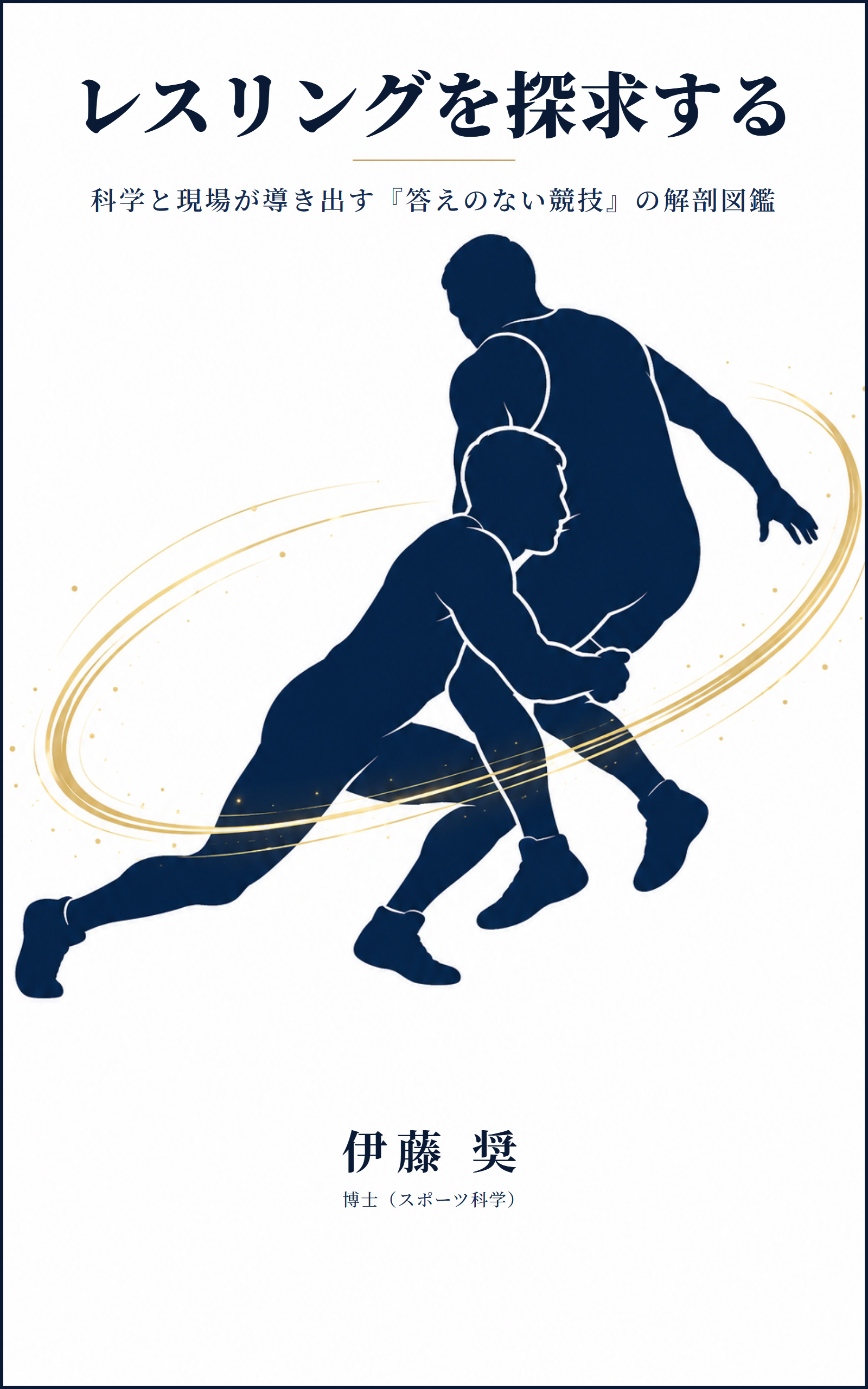
The author of this blog has written a Japanese-language book that examines the hidden mechanisms of wrestling from both research and coaching perspectives. Kindle edition 1,250 yen, paperback 2,500 yen, also included with Kindle Unlimited.
Paperback (2,500 yen) →Kindle (1,250 yen) →
Updates are sent through our official LINE account. / See the book page
コメント